ROOM TONE 


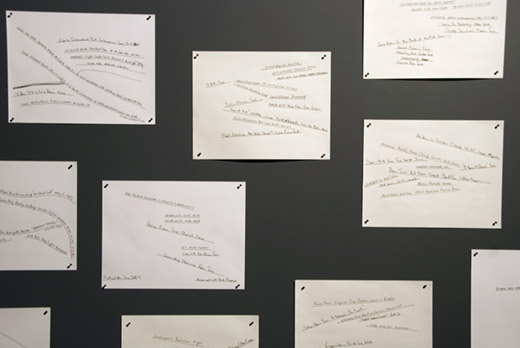
Chris Kubick & Anne Walsh Room Tone, 2007 4-channel audio installation, variable duration @ Rhinecliff Amtrak train station A room tone is a recorded element of sound design, often employed in the movie industry, to impress the sonic ambience of a depicted environment. It is the sound of “silence” in a room, though never quite silent as each room tone is inflected by different characteristics such as sonic reflections bouncing off physical architecture, the absorptive presence of bodies, and other kinds of technology present (i.e., the subtle hum of air-handling systems and lights). Room Tone is run by a computer program that generates sounds drawn from a database of approximately 1,000 room tones through four separate channels. The program may layer, cut up, and combine these room tones, varying in duration and volume, to create a new, dynamic, and visceral room tone for any particular space. Constantly changing and evolving, the aural experience of Room Tone humorously plays with the oft-cited adage of John Cage: “There is no such thing as an empty space or an empty time. There is always something to see, something to hear. In fact, try as we may to make a silence, we cannot.” Chris Kubick and Anne Walsh, both Oakland-based artists, produce sculpture, works on paper, video, video games, audio CDs and sound installations. From 2001 to 2005, their project Art After Death centered on the overlaps of metaphysics and art history. From 2004-2007, they produced works from a massive commercial sound effects library, exploring the rhetorical and sculptural dimensions of these complex cultural archives. In recent video projects, they continue to work with specialist performers and craftspeople to focus on the residue of fantasy left behind at “historical” sites and monuments. Chris Kubick is a sound designer and lecturer in new media and sound art at U.C. Berkeley. He is also the founder and director of Language Removal Services. Anne Walsh is a contributing editor of X-Tra Art and Culture Quarterly, a blogger for San Francisco MoMA, and is an associate professor of art at U.C. Berkeley.
room_tone_installation_01.jpg

Room Tone, 2007

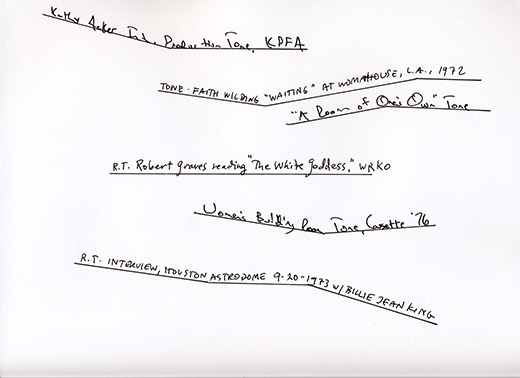
Collaboration with Chris Kubick 4 channel sound installation with drawings

Commissioned by Artists space, NY. Subsequent installations at Rhinecliff Amtrak Station/Bard College and Walter Phillips gallery, Banff Centre for the Arts

A room tone is a recorded element of sound design, often employed in the movie industry, to impress the sonic ambience of a depicted environment. It is the sound of “silence” in a room, though never quite silent as each room tone is inflected by different characteristics such as sonic reflections bouncing off physical architecture, the absorptive presence of bodies, and other kinds of technology present (i.e., the subtle hum of air-handling systems and lights). Room Tone is run by a computer program that generates sounds drawn from a database of approximately 1,000 room tones through four separate channels. The program may layer, cut up, and combine these room tones, varying in duration and volume, to create a new, dynamic, and visceral room tone for any particular space. Constantly changing and evolving, the aural experience of Room Tone humorously plays with the oft-cited adage of John Cage: “There is no such thing as an empty space or an empty time. There is always something to see, something to hear. In fact, try as we may to make a silence, we cannot.”

27-rt-drawingweb-500px.jpg
 
24-rt-drawing.jpg
 
27-rt-drawing.jpg
 
 
02_rt_drawing.jpg
 
01_rt_drawing.jpg